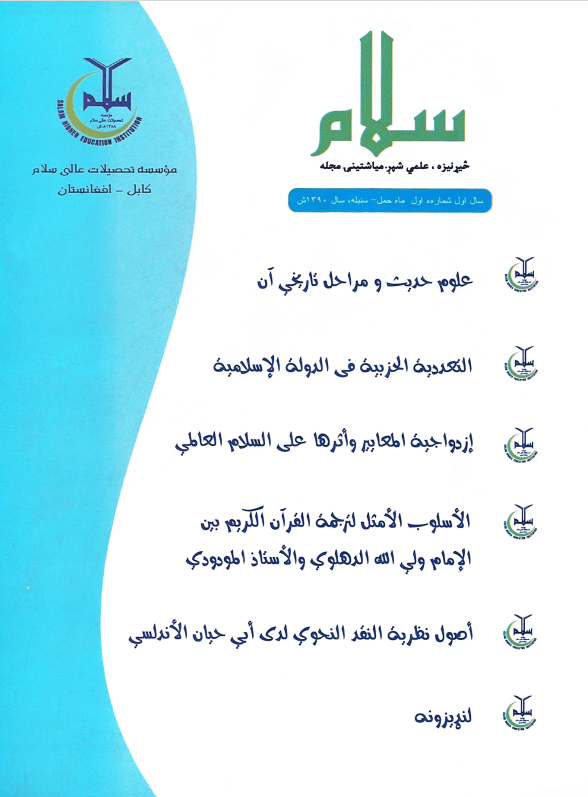
Multi-party system in an Islamic state
DOI:
https://doi.org/10.64104/v1.n2.2011Keywords:
Political pluralism, Islamic state, Islamic parties, doubts, alternativeAbstract
In this research the author addresses an important issue: Does the Islamic system require the establishment of political parties? And what is the ruling of their formation according to Sharia? Does Islam permit it or not?
The study examines various opinions on this matter. Some scholars argue that political parties have no place in an Islamic system because they are a product of democracy and lead to division and discord among Muslims. Others contend that forming parties is necessary to resist tyrannical and oppressive rulers and to fulfill the duty of enjoining good and forbidding wrong, as organization serves as a means to achieve reform.
The study also addresses doubts regarding the multiplicity of parties, such as the claim that disagreement is prohibited by Sharia. The response clarifies that only disagreements that lead to division are forbidden, whereas diversity of opinions for the public interest is permissible.
The study then presents alternatives to political parties, such as professional unions and the system of enjoining good and forbidding wrong, which achieve the objectives of consultation (Shura) and accountability without the harms associated with parties.
In conclusion, the study finds that political parties are neither inherently necessary nor inherently forbidden; their ruling depends on public interest. If an effective Shura system exists to monitor authority, there is no need for parties. However, if such a system is absent and reform can only be achieved through organization, establishing parties becomes permissible and even obligatory, provided that Sharia principles and good intentions are observed.